Lessons from Professor Jiang
The game, not the players, determines the result.
Most explanations of world events start with people. This one starts with the board.
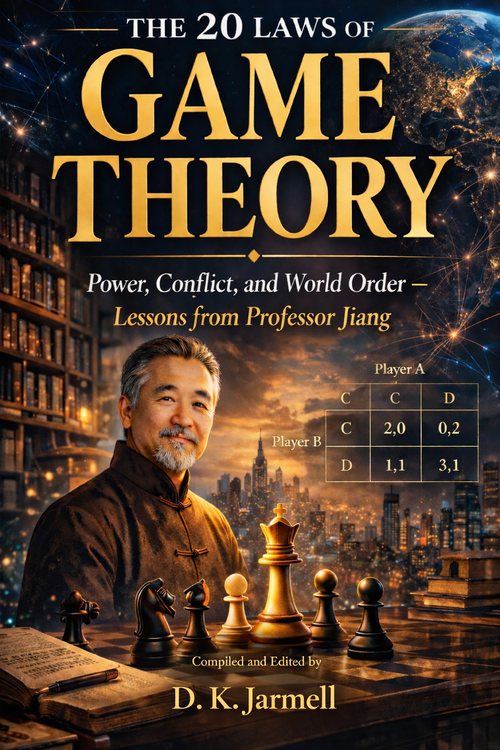
How does power actually work? Not who holds office, but what decides the outcome. This site answers that with game theory: count the players, read the rules that are genuinely enforced, establish what each side is rewarded for — and the result becomes readable in advance.
Presidents change. Alliances shift. Technologies arrive and are absorbed. Underneath all of it sits something slower and far more predictable.
Over two semesters, Professor Jiang Xueqin taught a course built on that single claim. The first four books are that course — compiled, edited and extended. The fifth goes down a level, into the money system every reader already lives inside.
What is the method?
It has one signature move. Take what an institution says it is for, then look at what it reliably produces. Where the two have diverged for decades, while remedies existed and were refused, stop calling it failure.
It is design.
Read how the method works, in four questions → · See all 27 laws of the series →
The five books
Book One
The 20 Laws of Game Theory
The first semester. Twenty laws, built on situations you have lived through — schools, money, migration, work — then extended to banking, empire and war.
What the twenty laws of Book One sayBook Two
The Final Laws of Geopolitical Game Theory
Chokepoints, strangulation, grand strategy, machine intelligence. Seven further laws, and the framework that ties all twenty-seven together.
The seven laws that complete the systemBook Three
Nash Equilibrium
The mechanism underneath everything else: why intelligent people build outcomes that nobody wanted and nobody can escape alone.
Why stable outcomes can be bad for everyoneBook Four
The Rational Prophet
The method turned forward. Twenty-six numbered bets on power, money and war — each with a public source, a threshold that decides it, and a date it expires.
How the method forecasts, and how to score itBook Five
The Laws of Money
The method goes down a level. Nineteen laws applied to banking, inflation and currencies — why money always works this way.
Why the bank run, the hidden tax and the peg all run on the same rulesThe weekly analysis
Every Monday, one story from the week put through the same instrument: players, rules, incentives — and the outcome the structure is pushing toward.
No opinions about who is right. Only what each side is paid to do next.
Why this exists. Reading the news by personality is entertaining and almost always wrong. Leaders are the least stable element of any system: they retire, lose elections, change their minds. Structures move at the speed of demographics and debt — slowly, visibly, and measurably. That is what makes them worth reading.
Last reviewed 27 September 2026