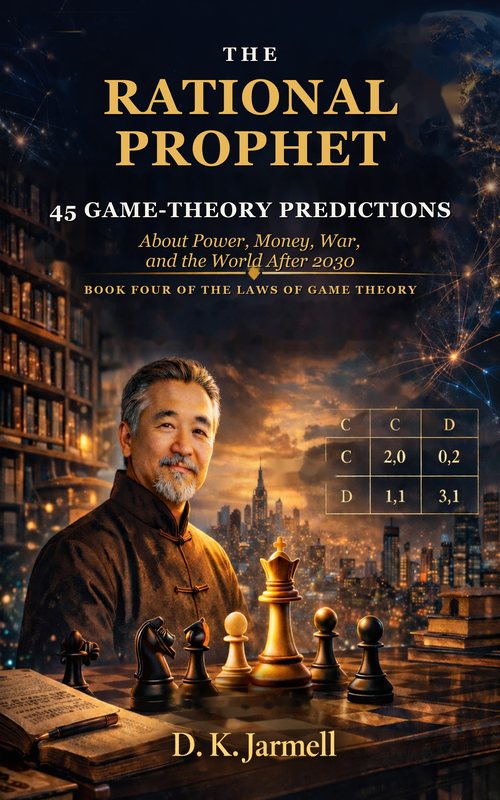
The Rational Prophet
45 Game-Theory Predictions About Power, Money, War, and the World After 2030 — Lessons from Professor Jiang
Book Four of The Laws of Game Theory
Nostradamus wrote in riddles. He had to. A prophecy vague enough can never be wrong, and a prophecy that can never be wrong can never be useful.
This book makes the opposite bet. Every prediction in it is numbered, dated to a band of years, graded by confidence, and written so that it can fail. All forty-five are collected in an appendix — the Prediction Ledger — where you are invited to do something no reader of Nostradamus could ever do: keep score.
Why thirty years is easier than three
It sounds backwards, and it is the argument the whole book rests on.
Over three years, noise dominates: personalities, accidents, elections, luck. Over thirty years, noise averages out and structure is what remains. Everyone who will be forty in 2060 has already been born. Most of the debt that will shape the 2030s has already been issued. The geography that will decide the resource conflicts of the 2040s has been fixed since the ice age.
The prophet who works from structure is not seeing the future. He is reading the present carefully.
How the book is built
Part I sets out the method honestly, including what it cannot do. Part II takes it into the archive — five centuries of empire cycles, a century of monetary breakdowns, and the clustering of great wars around power transitions — because a framework that cannot explain the past has no licence to describe the future.
Parts III, IV and V play the three great games forward: Power, Money and War. Part VI puts every prediction on a single timeline, decade by decade, and closes by teaching you to run the method yourself.
What is in the ledger
Each of the forty-five entries gives you four things: the players who can actually choose, the game they are inside, the incentives each is rewarded and punished for, and the outcome that follows — with the law of the series it follows from.
Nineteen of them go further and state, in advance, exactly what would prove them wrong.
A sample
P25 — No global nuclear war before 2060. Confidence: medium-high. Deterrence holds where a second strike is secure.
What would prove this wrong: any use of strategic nuclear weapons between major powers.
P39 — World population peaks in the 2050s or 2060s; East Asia and Europe shrink outright; no pro-natal policy anywhere reverses fertility decline. Confidence: high. The cohorts are already born; policy has no lever.
P13 — The debt supercycle resolves through financial repression and inflation, not through default or a growth miracle. Confidence: high. It is the only exit consistent with every player's incentives.
Who it is for
Readers who want a structural, incentive-first framework for the coming decades rather than commentary on the last one — and who would rather have a forecast that can be scored than one that can always be reinterpreted.
Publishing shortly Read the weekly analysis →
Not investment advice. The chapters on money describe what states, central banks and creditors have historically done under fiscal pressure, and what it cost the parties who misread it. Nothing in the book is a recommendation to buy, sell or hold anything.